
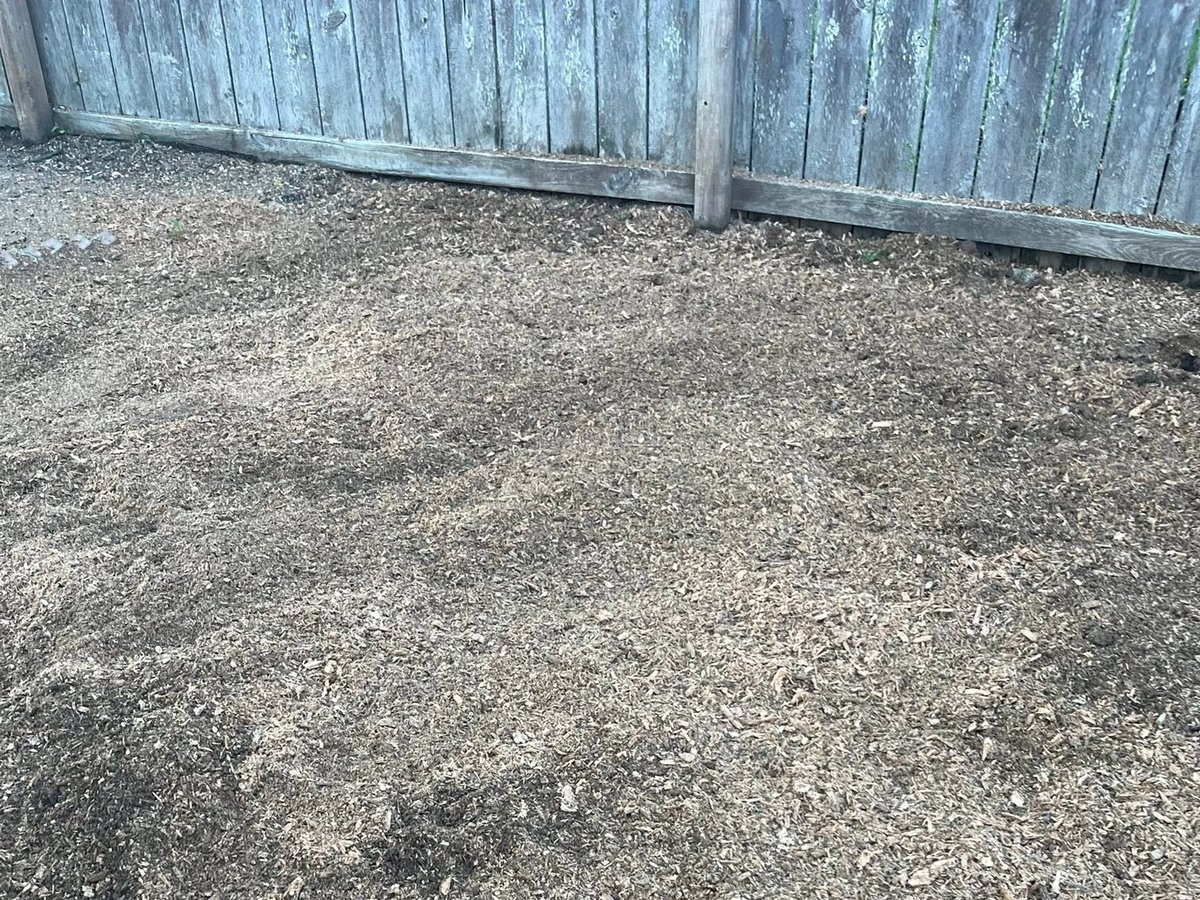
Once the grinder pulls out, you have a hole full of wood chips and usually a mound of extra chips on top of it. Here is what to do next: rake the chips out of the hole, fill it with topsoil a few inches at a time and pack each layer, leave the patch a little higher than the lawn around it, then sod or seed it. If you throw seed on the chips or roll sod right over them, the spot sinks and the grass struggles, usually within the first year.
Below is how we finish a stump hole around Millington, how much soil it actually takes, and what grass can go in depending on the month. If your stump came out this fall, the timing section is the one to read.
Why the spot sinks if you leave the chips in
Stump grindings are mostly wood and air. As they rot they shrink, and whatever is sitting on top drops with them. Sod laid straight over a chip-filled hole looks fine the day it goes down and turns into a soft dip a season or two later.
The second problem is nitrogen. Wood chips spread on top of the ground as mulch don't rob the soil, but chips mixed down into it do, because the microbes breaking down the wood use the same nitrogen the grass roots need (UC Agriculture and Natural Resources). A stump hole is exactly that situation: chips mixed with dirt, right where new roots are supposed to grow. Grass on top of it tends to come in thin and pale.
Around here there is a third problem. Most yards between Millington and north Memphis are silt loam over clay. A chip-filled hole in clay works like a sponge sitting in a bowl: it soaks up a hard rain, holds it, and stays soft long after the lawn around it has dried out.
How to fill a stump hole, step by step
1. Rake the chips out, all the way down to soil
A flat shovel and a stiff rake do it. Get out everything down to the bottom of the grind, where you hit soil and the cut ends of roots. A few chips worked into the edges won't hurt anything. A layer of them buried under the new topsoil will.
2. Look at what is left in the hole
You will see the ends of roots that ran out from the stump. Those stay in the ground and rot on their own over the next few years without bothering grass (more on that on our stump grinding page). Pull out anything else the grinder turned up: chunks of bark, an old brick, a piece of fence wire.
3. Fill with topsoil in layers and pack each one
Put in 2 to 3 inches of topsoil, firm it down with a tamper or your boots, then add the next layer. Packing it in lifts like this is what keeps it from settling later. Dumping the whole hole full at once and stepping on the top only packs the top. A good test comes from UT Extension's guidance for lawn seedbeds: your footprint should sink no deeper than about an inch (UT Master Gardener turfgrass chapter).
4. Leave it about an inch high
Finish the fill slightly above the lawn around it and feather the edge out a foot or so, so the mower doesn't scalp a ridge. Even well-packed soil settles a little. A patch finished an inch high ends up flush; a patch finished flush ends up low.
5. Water it, wait, and top it off
Soak the patch, give it a few days, and fill any low spots before the grass goes down. A hard Mid-South rain is the best test you will get. If water stands on the patch afterward, it needs more soil, or it is sitting in a low part of the yard that needs a real drainage fix rather than another bag of dirt.
How much topsoil a stump hole takes
The hole is about as wide as the stump was at the ground, root flare included, and as deep as it was ground. Four to six inches is normal for a lawn; a spot getting a post or a slab gets ground deeper. Worked out as a simple cylinder:
| Width of the ground spot | Depth | Volume of the hole | In bags or yards |
|---|---|---|---|
| 3 feet | 6 inches | About 3.5 cubic feet | Two 2-cubic-foot bags |
| 4 feet | 6 inches | About 6.3 cubic feet | Three to four bags |
| 5 feet | 8 inches | About 13 cubic feet | About half a cubic yard |
| 6 feet | 12 inches | About 28 cubic feet | About one cubic yard |
Buy a little more than the table says. The extra goes into the crown and into topping off after the first rain. Once you are past a cubic yard, or filling several holes, price bulk topsoil before you start hauling bags.
What to do with the leftover chips
A single stump often leaves more chips than the hole can hold, because loose chips take up far more room than the solid wood did. Some good places for them:
- Mulch for beds and around trees. On top of the soil they're fine for plants, as the UC source above explains. Keep them pulled back from trunks.
- Paths and the hard-to-mow strips along a fence line, behind a shed, or under a swing set.
- The compost pile, mixed in with leaves and grass clippings.
- Hauled off. If you don't want them, ask when you get the estimate. We price hauling on its own, so you can take it or leave it.
The one place they don't belong is buried in the hole under new grass, or heaped against fence boards or siding, where they hold moisture right where you don't want it.
Sod or seed, and when, in West Tennessee
Sod can go down almost any time of year here. Seed has narrow windows. According to the University of Tennessee's turfgrass guidance, sod is installed in Tennessee throughout the year as long as the ground isn't frozen; bermudagrass and zoysiagrass seed should go in between May 1 and June 30; and tall fescue seed belongs in late summer or early fall, no later than mid-October. Dormant bermuda or zoysia sod laid in winter can take several weeks or months to root before it handles foot traffic (UT Master Gardener turfgrass chapter).
Put together, here is what that means for a stump hole:
| When the stump came out | What to do with the patch |
|---|---|
| March and April | Fill and crown it now. Sod bermuda or zoysia once the lawn greens up, or seed bermuda starting May 1. |
| May and June | The best window of the year. Sod or seed bermuda or zoysia. |
| July and August | Sod, and keep it watered through the heat. In shade, fescue seed can go in from late August. |
| September to mid-October | Seed fescue in shady spots. Sod bermuda or zoysia while it is still growing. |
| Late October through February | Fill and crown it now so it settles over the winter. Lay dormant sod if you want it covered, or top it off in March and sod or seed in spring. |
Match the patch to what is already growing. Most sunny yards in the Millington area are bermuda or zoysia, which take the Mid-South summer. Fescue wants shade and steady water. One thing people miss: if the tree you just lost was the one shading that corner, the grass that grew under it may not be the right grass anymore. A fescue patch that suddenly sits in full afternoon sun will have a rough first July.
If you are reading this in late fall, the patch doesn't have to wait for spring. Getting the chips out and the soil packed now gives it the whole winter to settle and get rained on. You top off whatever sank in March, and the grass goes onto ground that has already done its moving.
Planting something other than grass
A new tree. Not in the same hole, or not right away. The old root mass is still down there competing for water. Plant a few feet over, the same advice we give on the stump grinding page.
A flower bed. The easiest option, since a bed doesn't show a little settling the way a lawn does. Still pull the chips out of the hole and fill it with soil and compost rather than planting into grindings.
A patio, a slab, or a fence post. These need the stump ground deeper and the fill compacted hard, or whatever goes on top settles with it. Tell us before the grinding starts and we'll take it down further. Our concrete, hardscape and fence work all start with that base.
When it makes sense to hand it off
One small hole is a Saturday with a wheelbarrow, and most people can do it well with the steps above. It is a different job when there are several stumps, a whole corner where a big oak or pecan came down, or a spot that already holds water after a rain. That is where it pays to have it done in one pass: chips out, topsoil in and packed in layers, graded to the lawn around it, and sod laid and rolled.
Because we're the ones grinding the stump, we can finish the spot on the same visit or come back for it, and the sod is priced separately from the grinding. We work from Millington across Atoka, Munford, Covington, Bartlett and the rest of the area we serve. If you want a number, send us a photo of the spot with something in it for scale.